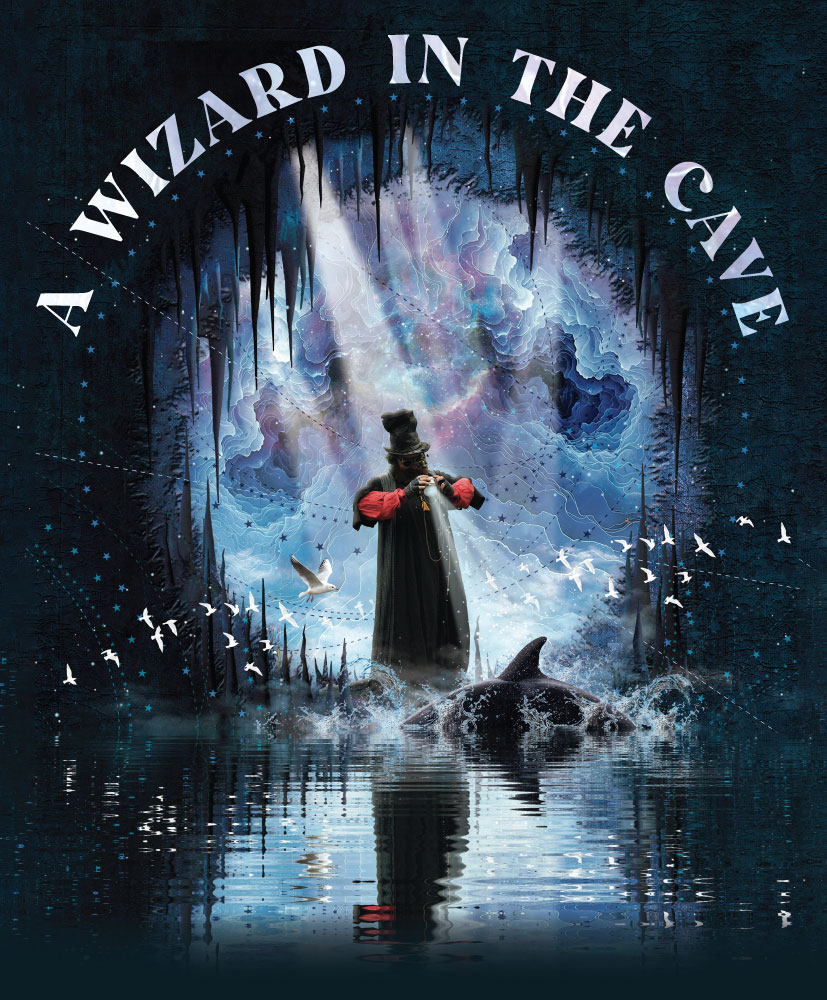
ADDITIONAL PROGRAMME
A solo performance inspired by the life of Marin Getaldić
Written by Filip Krenus
Directed by Paul Anthony Morris
Performed by Thomas Michaelson
Slanica (Revelin), Dubrovnik
30 June at 9.30 p.m.
FREE ADMISSION
Performed in English
‘Strange thing, a mirror.
It does not keep a face.
Only light.’





SMOKE AND MIRRORS
The story began with a rumour.
A man stands beneath the cliffs outside Dubrovnik holding mirrors toward the sun. Tiny model ships wait upon the water. Smoke begins to rise from wood touched only by light. The watching crowd whispers. Soon the city begins calling him a wizard.
Before writing this piece, Marin Getaldić existed in my imagination mostly as a distant historical figure — mathematician, scientist, philosopher. But the image of Betina Cave changed everything. Suddenly the story no longer felt academic. It felt theatrical.
A Wizard in the Cave is not a conventional biography. It is a chamber play inspired by the life, obsessions and solitude of a man suspended between science and magic, reason and superstition, light and darkness. Accessible today only by sea, Betina Cave itself became the emotional centre of the piece: part laboratory, part sanctuary, part prison, part dream.
Written for the 400th anniversary of Getaldić’s death, the production follows a solitary figure reconstructing fragments of his life through mirrors, memories, sea-light and reflection. Performed by Thomas Michealson and directed by Paul Anthony Morris, the piece embraces intimacy, illusion and theatrical imagination rather than historical reconstruction.
This text also serves as an introduction to the forthcoming illustrated companion book A Wizard in a Cave, created in collaboration with artist Zdenko Bašić, whose artwork shaped much of the visual world of the production itself.
Perhaps theatre and mirrors are not so different after all. Both borrow light briefly before releasing it back into darkness.
About the play
Before writing this play – before descending, imaginatively at least, into the strange darkness of Betina Cave – I knew roughly as much about Marin Getaldić as most people in Croatia probably do. His name drifted somewhere between a schoolbook footnote and a certain optician’s shop window. A mathematician, perhaps. A scientist. A vaguely important Ragusan mind from the Renaissance. One of those names we inherit respectfully, while quietly hoping someone else remembers the details.
Then I encountered the story of the cave.
A man stands beneath the cliffs outside Dubrovnik holding mirrors toward the morning sun. Tiny model ships wait upon the water. Smoke begins to rise from wood touched only by light. The watching crowd whispers. Some cross themselves. Others retreat in silence. Soon the city begins calling him a wizard. And suddenly the story became theatre. Not simply because of the visual beauty of it – though it possesses that in abundance – but because it revealed something much larger and stranger: that fragile historical moment when science still resembled sorcery, when mathematics still felt dangerous, and when a man studying optics could easily become a figure of suspicion, rumour, or myth.
I have always been fascinated by that threshold.
The borderlands between illusion and discovery. Between alchemy and astronomy. Between theatrical trickery and genuine revelation. Smoke and mirrors are, after all, the oldest tools of both magicians and theatre-makers. The Renaissance itself often feels like a stage suspended between two worlds: medieval darkness slowly giving way to reason, while still haunted by superstition, omens, symbols, prophecies, and invisible correspondences.
Even Isaac Newton searched for hidden codes in Scripture and experimented with alchemy. John Dee conversed with angels while helping shape navigation and empire. The modern world did not emerge cleanly from reason alone. It emerged through confusion, obsession, imagination, fear, and wonder.
And Marin Getaldić stands precisely there.
A mathematician of extraordinary intelligence. A diplomat. An optician. A traveller moving through England, France, Italy and the Low Countries in pursuit of knowledge and intellectual companionship. A man fascinated by symbolic algebra, geometry, light, mirrors and the invisible architecture hidden beneath the visible world. And yet also a man trapped. Following a duel in Rome, Getaldić found himself forced back into Dubrovnik, unable to continue the wider intellectual life he longed for abroad. In letters, he described Dubrovnik almost as a tomb. That image haunted me immediately: a brilliant mind returning home unfinished, pacing within the beautiful limitations of a small republic suspended between sea and stone. It somehow felt deeply contemporary.
Because many artists, scientists and intellectuals from smaller nations understand this paradox instinctively. Recognition often arrives elsewhere first. The horizon always seems to lie abroad. One leaves in search of possibility and returns carrying both knowledge and exile within oneself.
And then there is the cave itself. Betina Cave is not merely a location. It feels mythological. Accessible today only by sea, hidden beneath the cliffs, it once connected to the family estate above through a steep and dangerous staircase that no longer exists. Even before writing a single line, I could already hear the sound design of the piece: waves beneath stone, distant echoes, breathing darkness, fragments of reflected light trembling across the walls like broken constellations.
It did not feel like the setting for a historical biography. It felt like memory. The more I researched Getaldić, the clearer it became that the play could not proceed in a straightforward chronological manner. The facts of his life are fascinating, but they are not “dramatic” in the conventional theatrical sense. His true drama lies elsewhere: in thought, isolation, obsession, exile, imagination, and the terrifying beauty of trying to understand the universe while surrounded by people who suspect you may be summoning demons.
So the structure gradually transformed into something more dreamlike. A chamber piece. A memory play. A solitary figure inside a cave reconstructing his life through reflections, fragments, mirrors, projections, stars, rumours, equations, and sea-light. A man who spent his life attempting to bring clarity to the world, only to discover that reality itself keeps breaking apart into reflections. The cave became laboratory, theatre, prison, sanctuary, observatory, and tomb all at once. And naturally, because I cannot entirely resist theatrical playfulness, it also became a stage inhabited by ghosts, commedia echoes, sea monsters, scholars, drowned sailors, mirrors, and mathematical spells disguised as equations.
In many ways, this piece continues conversations I began years earlier in Rougher Magic, my play inspired by the life of John Dee. I remain fascinated by individuals standing on the edge of historical transformation: people who sense the future arriving before the rest of the world possesses the language to describe it. Such figures often appear absurd or dangerous to their contemporaries because they are looking slightly beyond the visible horizon. Getaldić seems to me one of those people. Not merely a Croatian scientist deserving respectful commemoration, but a profoundly theatrical figure. Solitary. Brilliant. Restless. Melancholic. Occasionally comic. A man capable of turning sunlight into flame while still being forced to spend much of his life dealing with diplomacy, administration, inheritance disputes, and the exhausting practicalities of survival.
That contradiction also moved me deeply. History tends to imagine great minds existing permanently inside moments of revelation. In reality, most genius survives through paperwork, exhaustion, compromise, patronage, accounting, delayed travel arrangements, politics, and badly paid obligations. Getaldić might have transformed mathematics further still had circumstance allowed it. Yet perhaps the tragedy – and beauty – of his life lies precisely there: in the distance between potential and possibility.
This production was commissioned to mark the 400th anniversary of Marin Getaldić’s death, and it feels strangely fitting that the play returns him to the cave where legend and history still blur together. The production itself could not exist without collaborators capable of embracing both its intellectual and imaginative demands. Thomas Michealson brings extraordinary sensitivity, humour and humanity to the role of Getaldić, while director Paul Anthony Morris – with whom I previously collaborated on Conundrum at the Young Vic and later in Rijeka during the European Capital of Culture programme – understands instinctively how to balance theatricality with emotional intimacy.
Because ultimately this is not a lecture disguised as theatre. Nor is it simply a historical reconstruction. It is a meditation on light. On reflection. On loneliness. On knowledge. On illusion. On the dangerous beauty of curiosity. And perhaps above all, it is about the strange human need to keep searching even when certainty remains impossible.
Getaldić spent his life studying mirrors, yet the play gradually revealed something unexpected to me: mirrors do not truly preserve anything. They only borrow light briefly before releasing it again. Theatre may not be so different. For an hour or two, we gather shadows, voices, memories and reflections inside darkness. Then they vanish. The audience departs. The cave empties. Only fragments remain.
But sometimes, if we are fortunate, the light lingers a little longer on the walls.
Filip Krenus
Historical Note
Marin Getaldić (Marino Ghetaldi, 1568–1626) was a Dubrovnik mathematician, physicist, diplomat, optician, and one of the most significant scientific minds of the late Renaissance. Celebrated throughout Europe for his work in geometry and optics, he belonged to the intellectual circle that transformed the foundations of mathematics and natural philosophy at the dawn of the modern age.
Educated in Dubrovnik before travelling extensively through England, France, Italy, and the Low Countries, Getaldić came into contact with some of the greatest scientific figures of his era, including François Viète, Christopher Clavius, and Galileo Galilei. Deeply influenced by the emerging language of symbolic algebra, he helped unite algebra and geometry in ways that anticipated later developments in analytic mathematics.
Among his most important works are Promotus Archimedis (1603), Nonnullae propositiones de parabola (1603), and Apollonius Redivivus (1607, 1613), devoted to geometry, parabolic mirrors, optics, and the reconstruction of lost classical mathematics. His experiments with burning mirrors and reflected light became legendary in Dubrovnik, where local stories gradually transformed the scientist into a mysterious “wizard” associated with Betina Cave beneath the family estate outside the city walls.
Getaldić lived during a period when science still stood dangerously close to magic in the public imagination. Mirrors that ignited ships, lenses that altered vision, and mathematical symbols describing invisible truths appeared almost supernatural to ordinary observers. Yet behind the legends stood a restless and rigorous mind attempting to understand light, space, proportion, and the hidden order of the universe.
Following a duel in Rome, Getaldić was effectively prevented from continuing the wider European life he had envisioned for himself and returned to Dubrovnik, which he once described in letters as feeling “like a tomb.” Nevertheless, many of his most important scientific works were created during this final period of isolation.
Written to mark the 400th anniversary of Marin Getaldić’s death, A Wizard in the Cave is not intended as a literal biography, but as a poetic meditation on memory, exile, science, illusion, and the fragile border between reason and wonder. Like the fragmented reflections within the cave itself, the play approaches Getaldić through shards: letters, legends, equations, rumours, mirrors, and sea-light.
Four centuries after his death, Marin Getaldić remains one of the great – and still too little known – figures of the Croatian Renaissance.
CREDITS
- Written by FILIP KRENUS
- Directed by PAUL ANTHONY MORRIS
- Performed by THOMAS MICHAELSON
- Artwork by ZDENKO BAŠIĆ
- Set and Prop Consultant: TIN VLAINIĆ
Special thanks to UCL University, Professor Wendy Bracewell, Dr Uta Staiger, and Midsummer Scene Festival team
FILIP KRENUS
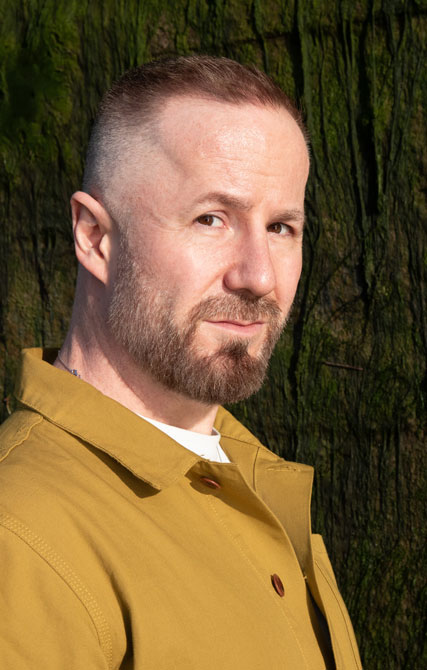
Filip Krenus is a Croatian writer, translator and theatre-maker based in London. He is co-founder and Creative Director of Midsummer Scene Festival in Dubrovnik, the largest English-language theatre festival in Southern Europe.
His English translations of Marin Držić, published by the House of Marin Držić, include Uncle Maroye (Dundo Maroje), Old Stan or A Fool Fooled (Novela od Stanca), Pinch Hoard (Skup) and Plakir, Son of Cupid. For Pinch Hoard and Plakir, he also reconstructed the missing endings in Renaissance English for contemporary performance.
With director Sean Aita, he co-wrote A Poor Player, which toured internationally, while his play Rougher Magic, inspired by the life of John Dee, was shortlisted for the ESFN ShakesPHERE New Play competition.
His forthcoming project A Wizard in a Cave, inspired by the life of Marin Getaldić and accompanied by an illustrated companion book by Zdenko Bašić, continues his exploration of myth, illusion, Renaissance science and theatrical magic. His bilingual collection Necromancer Speaks, illustrated by Dubravko Kastrapeli, is also currently in preparation.
PAUL ANTHONY MORRIS
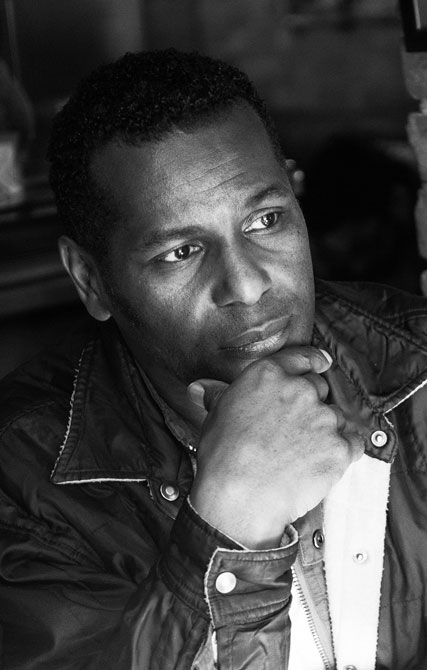
Paul Anthony Morris is the Founder and Artistic Director of Crying in the Wilderness Productions (CITWP). In 2006, Paul’s play, The Seer, was produced into a proof-of-concept short documentary film in collaboration with West Yorkshire Playhouse. In 2007, Paul wrote and directed, 35 Cents, at the Blue Elephant Theatre. In 2008. Paul won, The Adopt A Playwright Award, for his play Identity which was published by Oberon. In 2009, Paul worked as a script coordinator on two productions for, STORY MAKERS TV, which were screened at the Beautiful South film festival at the British Film Institute. Also, in the same year he directed, The Meeting, at the Warehouse Theatre. In 2010, Fostering Network commissioned Paul to write the play, Click, which was performed at Stratford Circus. In 2011, Paul directed an abridged version of, Invisible Man, at the Decibel Performance Arts Showcase; and in 2013, Paul directed the full-scale production of Invisible Man, to open the studio of the Bush theatre. In 2015, Paul wrote and directed, Sarai, at the Arcola theatre. In 2016, Centre Stage USA commissioned Paul to write, Gifted, and in 2017 he directed, Invisible Man, for the third time for the Certain Blacks Festival at the Rich Mix. In 2019, Paul became an Associate of the Young Vic theatre and the Associate director on, Tree, an Idris Elba story for the Manchester International Festival. In 2020, Paul wrote and directed an abridged 30-minute film production of Conundrum for the European Capital of Culture 2020, and in 2022 he directed the full-length production of Conundrum, at the Young Vic theatre. In 2022, Paul wrote, Heartbreak Hotel, which was commissioned by Essex University and performed at Bridwell Centre, and in 2024, Paul wrote Best Friends which has just completed a yearlong development process in 2025. In 2026 his play Best Friends was shortlisted for the Ilfed award.
Awards: FRINGE FIRST, Edinburg Festival, THE Adopt a Plaiwright Award, Offwestend and the Peggy Ramsay Award.
Published Plays Oberon : 35 Cents and Identity
THOMAS MICHAELSON
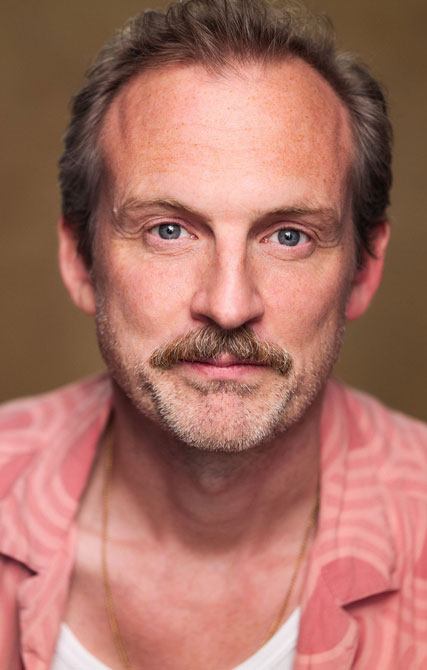
Thomas Michaelson is an actor, filmmaker and musician.
Theatre: Inter Alia at National Theatre & The Wyndham’s; The Father at The Wyndham’s & Duke of York’s; Hard Times at Oldham Coliseum; Twelfth Night for Vienna English Theatre; High Ridin’ at the King’s Head; Significant Other: Inc. at The Vaults; The Hound of the Baskervilles on tour and at Theatre Royal Windsor; Romeo and Juliet for Honey Tongued; The Duchess of Malfi at New Diorama; Cadfael: The Virgin in the Ice and The Importance of Being Earnest on tours; More Dead Girls at Theatre503; The Wonderful Discovery of Witches for Dawn State Theatre Company; and Macbeth for Titian Rep
TV: Black Ops (season two)
Film: Jack the Giant Slayer and short films, A Matter of Hate andDeath, Corona, Two Single Beds, Present and The Wing. Also as director: Human Relations, Patches, TheArrangement, Cup & Ball and The Man with His Fingers in His Ears Thomas Michaelson also founded Sonnets V Dementia, a fundraising project for Dementia UK.
A joint production of:


Supported by:


Silver sponsors


Bronze sponsors


Sponsors


Partners



Media Partners


Special thanks to